Omie & Irie and the Moonlight Garden
A Magic story for kids who like to learn stuff
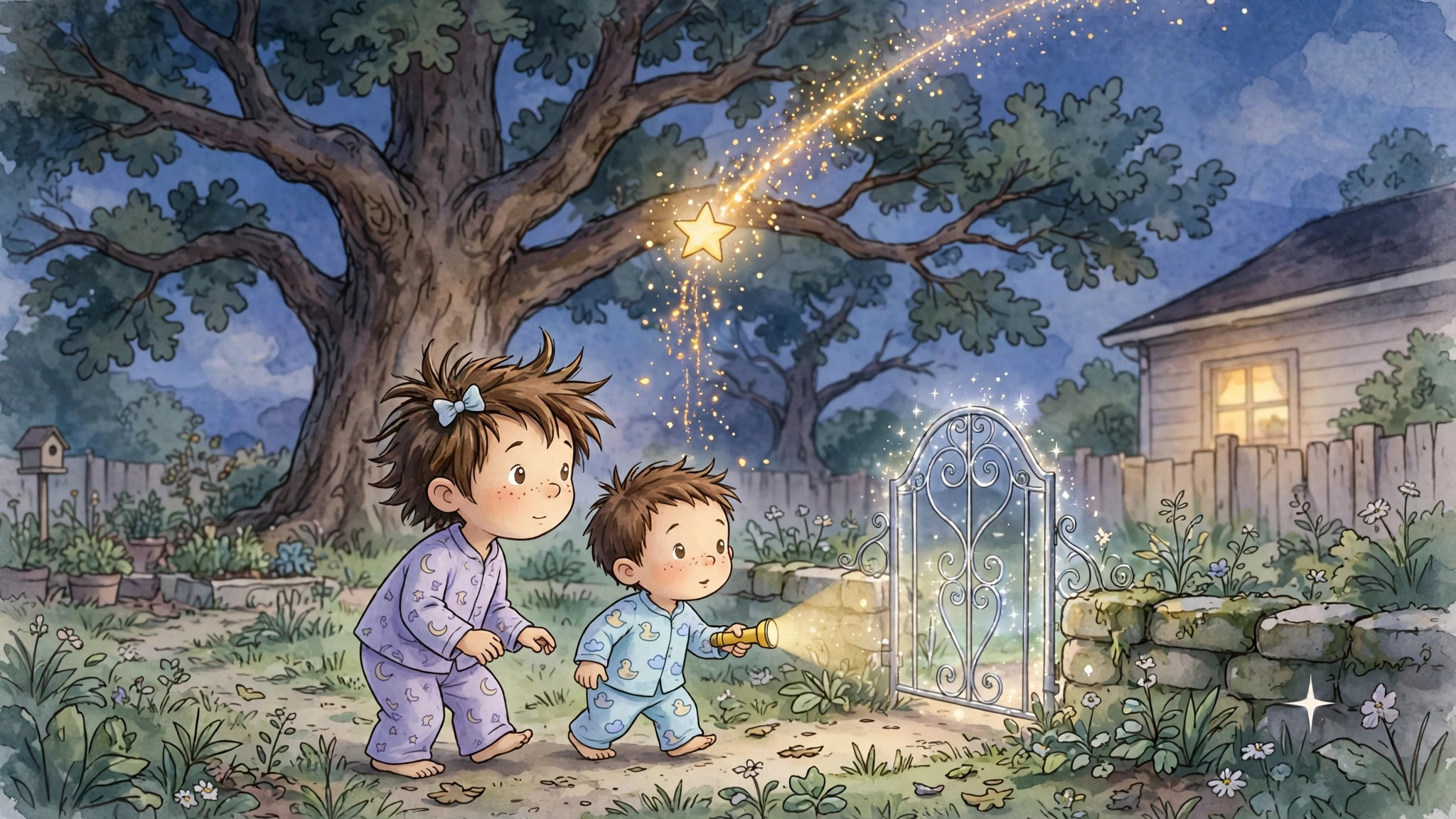
One evening, just as the sky was turning the color of blueberries, a star fell.
It did not fall far. It fell right past Irie and Omie's backyard, trailing golden sparks, and landed — poof — somewhere behind the old oak tree.
"Did you see that?" Irie whispered.
Omie, who was very small and very brave about star-chasing, nodded and grabbed his flashlight. Together, the two of them tiptoed past the oak tree, and found something that had definitely not been there that morning: a little garden gate, glowing silver, where no gate had ever been before.
The Garden That Only Blooms at Night
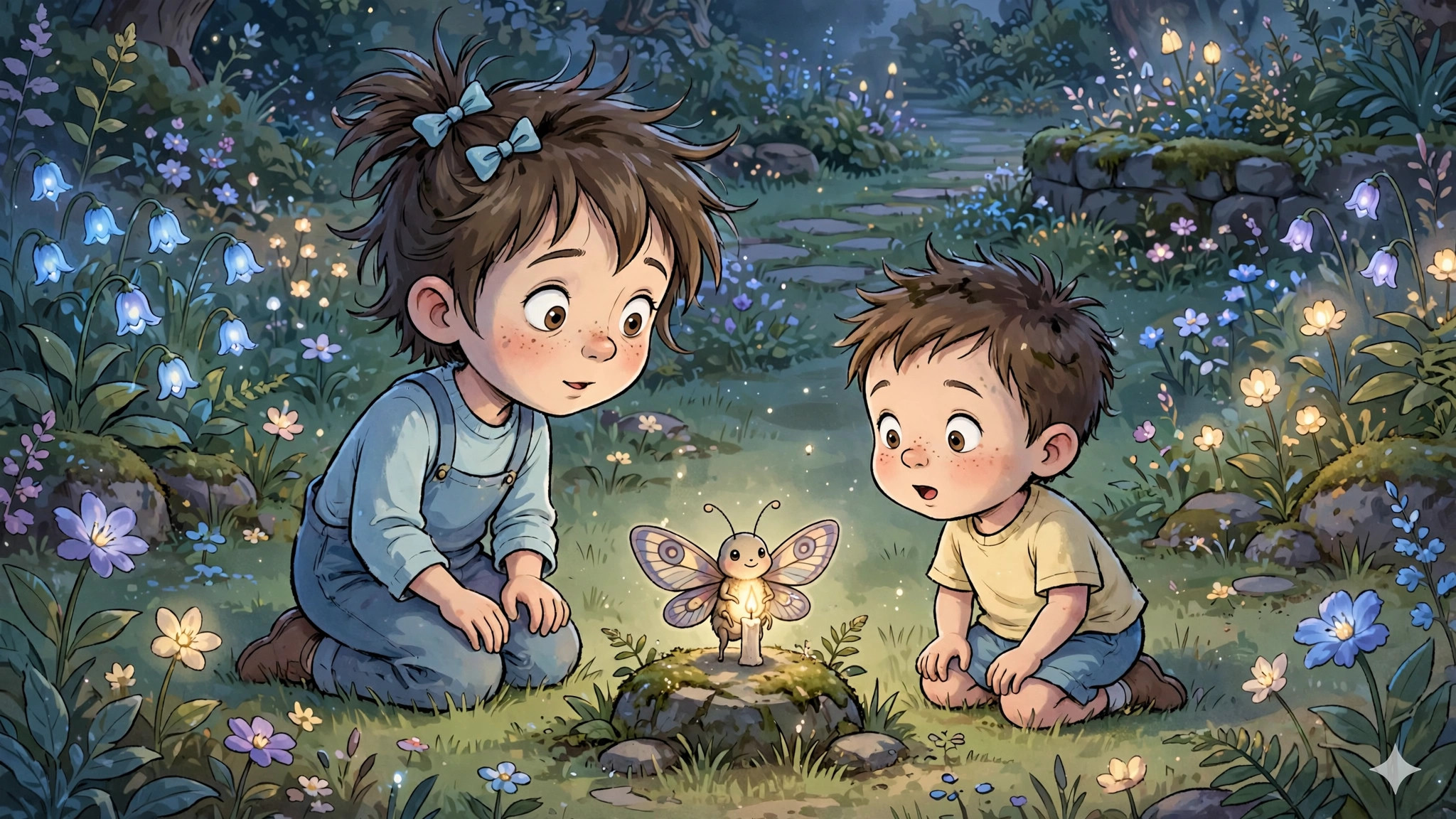
Beyond the gate was the Moonlight Garden. The flowers there did not open in the daytime at all. They opened only in moonlight, and they glowed — soft blue, gentle violet, pale gold — like a hundred tiny lanterns. In the middle of the garden sat a tiny creature with wings like a moth's and a light in her chest that flickered weakly, like a candle in the wind.
"Hello," said the creature, in a voice like a tiny bell. "I am Luma, a star sprite. I fell out of the sky, and my light is going out."
Irie knelt down. "Why is your light going out?"
"Because star sprites run on moonlight," Luma said. "And tonight the moon is only a sliver. There is not enough light to fill me up again."
The Lesson of the Moon
Irie looked up. Sure enough, the moon was a thin crescent, like a fingernail clipping of light.
"But wait," Irie said. "If the moon is only a sliver tonight, won't it grow again?"
Luma nodded. "The moon changes shape in the sky, night after night. People call those shapes the phases of the moon."
The Moon Lesson: The moon does not make its own light the way the sun does. It shines because sunlight bounces off it, like a mirror. As the moon travels around the Earth, we see different amounts of its sunlit side. That is why it looks like a sliver, then a half, then a big round full moon, and then it shrinks again. The whole cycle takes about a month. The moon is not really changing shape at all — we are just seeing its light from a different angle!
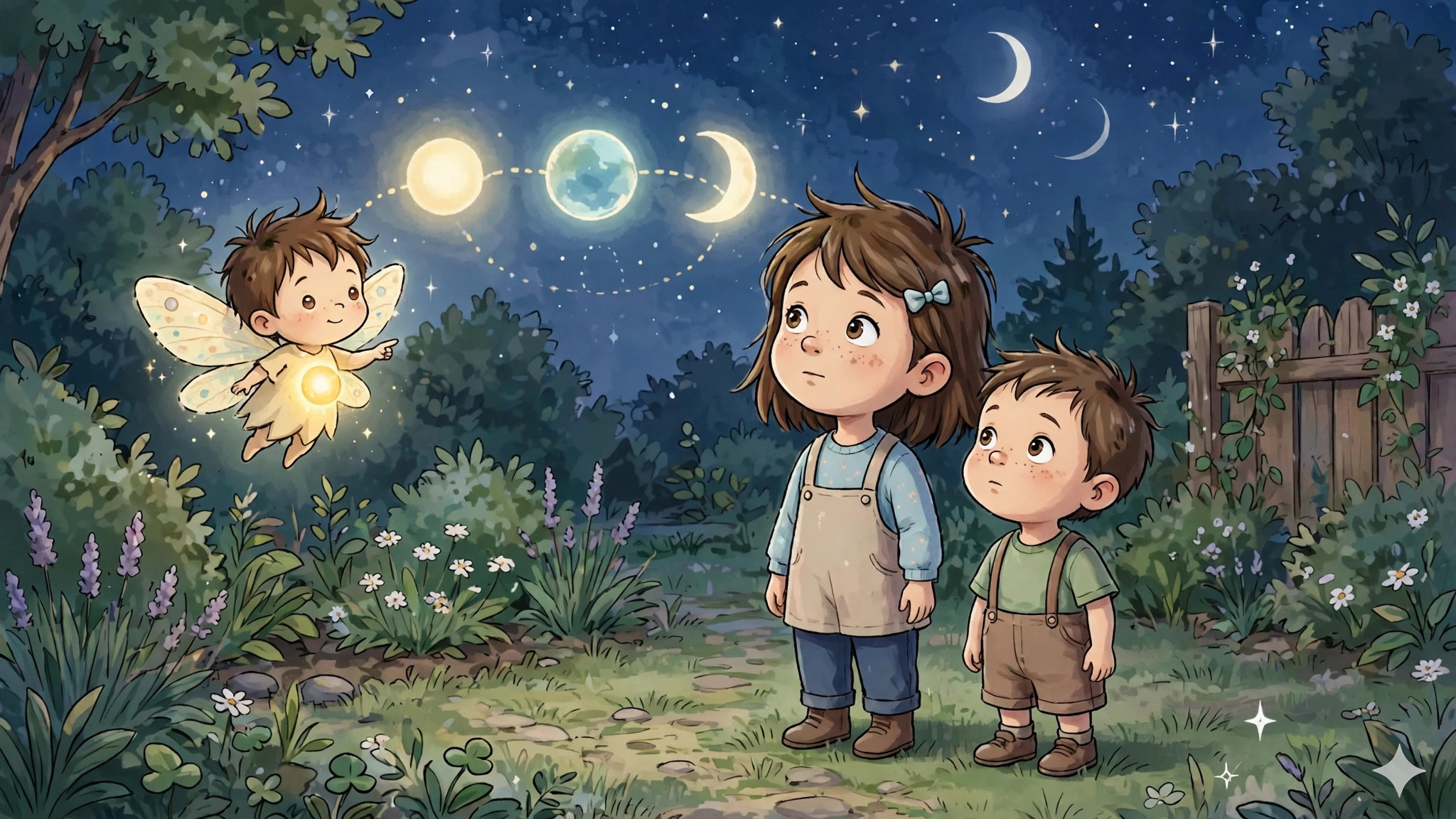
"So we just have to wait for the moon to grow?" Omie asked, in the way babies ask things, which is mostly by pointing at the moon and saying "Moon!" very firmly.
"Waiting takes many nights," Luma said, flickering. "And I am not sure my light will last that long."
The Mirror Lantern
Irie thought hard. Then she remembered something from science class: if moonlight is just reflected sunlight, then maybe you can catch it and bounce it, the way you bounce a ball.
"We need mirrors!" she said. "Lots of little mirrors, all pointed at you. Each one will catch a bit of moonlight and throw it your way. A little bit, times a lot of mirrors, equals a lot of light!"
Omie, who loved shiny things, immediately volunteered his spoon collection.
All that night, the two of them built the Mirror Lantern: a ring of spoons, a hand mirror, a shiny baking tray, and the hubcap from Dad's old bicycle, all angled toward Luma like a sunflower following the sun. And it worked. The thin crescent moon's light, gathered and bounced and gathered again, poured onto Luma in a soft silver river.
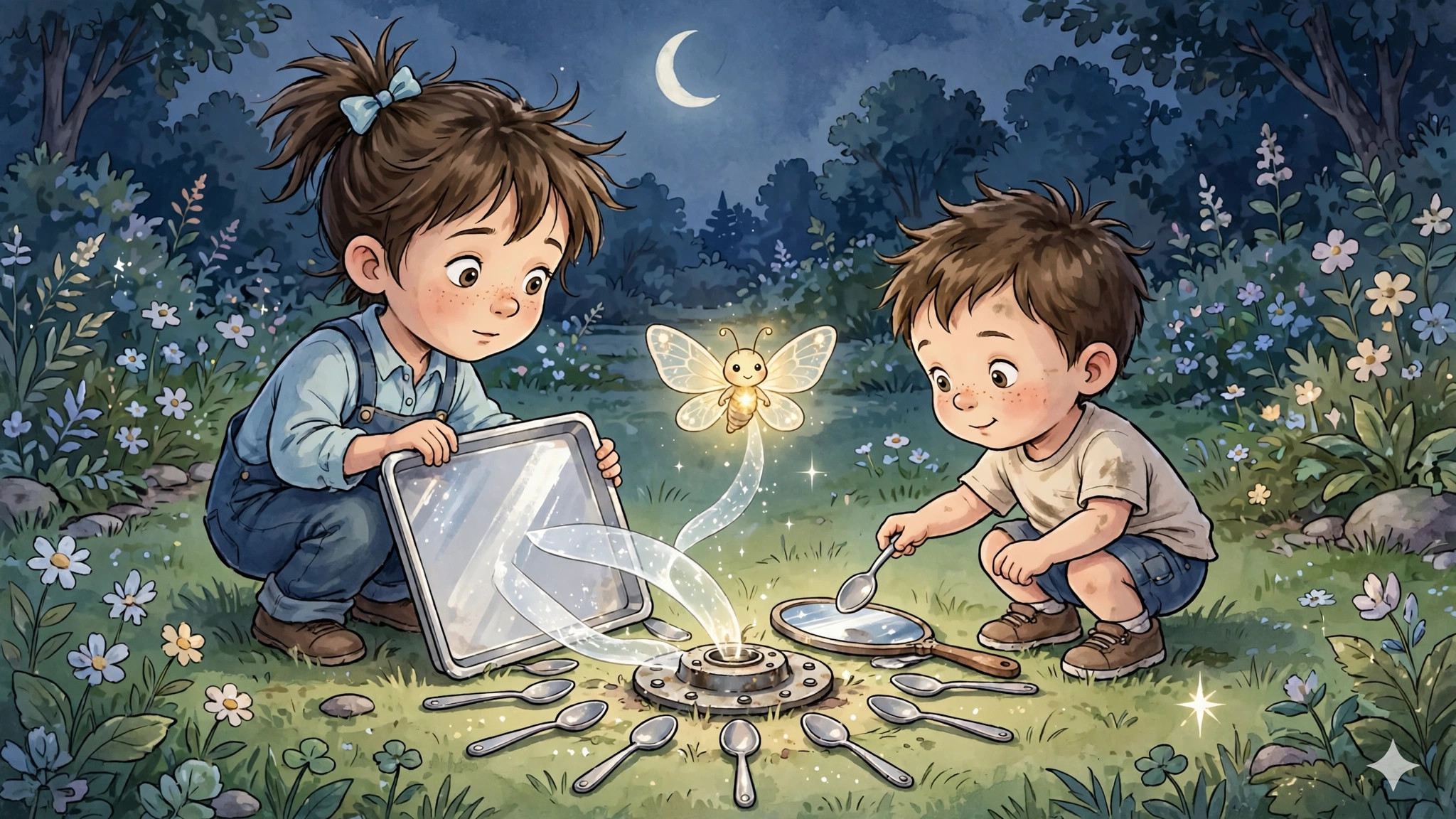
Luma's light grew steadier. Then stronger. Then, with a happy pop like a cork coming out of a bottle, it blazed bright gold.
Home by Full Moon
"I'm full!" Luma cried, spinning in the air and scattering sparks that turned into tiny glowing flowers wherever they landed. "Thank you! And now I know something: even a sliver of moon is enough light, if you know how to gather it."
As a thank-you, Luma promised to visit the garden every full moon, when her light would be brightest of all. And she kept her promise. If you go out on a full-moon night and look very carefully at the garden behind the old oak tree, you might see a little golden light dancing among the flowers — and two kids, one big and one small, waving back at it.
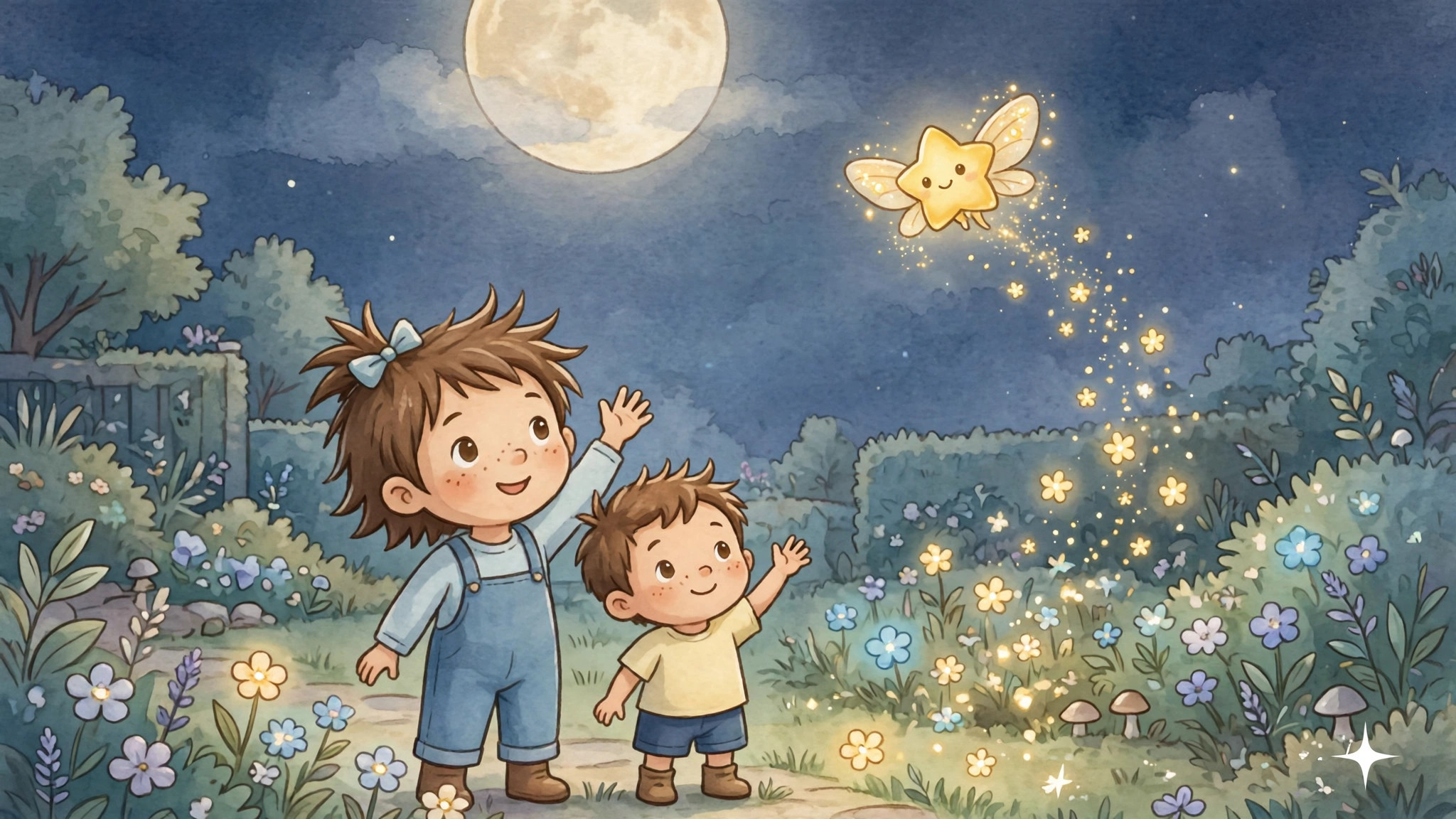
And Irie never forgot the lesson of the Moonlight Garden: the moon does not change. Only the light we see changes. And sometimes, a little light, gathered with care, is exactly enough.